
I. Why Do You Always Lose High-Value Return Disputes?
[Real Case]
A fishing gear seller shipped a 145cm lure fishing rod. Upon delivery, the buyer requested a return, claiming "cracks on the rod body and missing guide rings." The seller pulled up warehouse surveillance footage—the video only showed the back of a packing worker stuffing foam into a cardboard tube, with just the rod tip visible.
After platform mediation, the seller was unable to provide a pre-shipment video clearly showing the rod body's complete condition. The ruling was a full refund plus the seller bearing the return shipping cost. One fishing rod valued at ¥680, return shipping ¥35—a total loss of ¥715.
This isn't an isolated case. Over years of working with e-commerce packing surveillance, we've found that large items (over 70cm) are the absolute "epicenter of the disaster zone" for return disputes. The reason is simple: large items carry high product values, pass through many logistics touchpoints, and require large packaging areas, yet standard surveillance cameras on the market simply can't capture the full picture.
Pool cues, fishing rods, long down jackets, rolled yoga mats, computer chairs… Every single one of these 70cm+ items involves a far more complex packing process than small goods. Workers need to flip, wrap with stretch film, and stuff cushioning materials—the entire process can take 3–8 minutes. If your camera only has an 80×60cm field of view, it can't even fit the side of a pool cue in the frame. That is the very first pitfall large-item sellers step into when choosing packing surveillance.
II. Five Critical Selection Pitfalls—Hit Just One and Your Purchase Is Wasted
[Pitfall 01] Insufficient Field of View—Items Over 70cm Don't Fit in the Frame
Common mistake: Buying a camera advertised with an 80×60cm shooting range, thinking "that should be about enough." But when a 145cm pool cue is laid horizontally, both ends fall outside the frame—cracks on the rod body simply can't be captured.
When packing large items, workers need to flip, rotate, and stuff fillers on the packing table. If the field of view only covers part of the item, the uncovered portion becomes a blind spot in any dispute. If the buyer says "the crack is in the middle section of the rod" but that middle section is outside your video frame—how do you prove there was no crack at shipment?
Correct approach: The field of view must exceed the item's maximum side length by at least 20cm. For items over 70cm, you need at least 100×70cm or larger coverage. A device like the inboz-Plus with its 160×70cm field of view can cover the complete packing process for the vast majority of large items.
[Pitfall 02] Using 4K Instead of Zoom—Massive Files but Blurry Details
Common mistake: Hearing that 4K has high resolution, buying a 4K camera. Result: 4K video files are huge—recording all day fills dozens of gigabytes; zooming in on a courier barcode still yields a blurry image, because while 4K has high overall resolution, the local pixel density after digital zooming isn't enough to read 3mm barcode digits.
The core requirement for large-item packing surveillance is "seeing both the full picture and fine details." A 4K camera can capture the full view, but zoomed-in clarity is far inferior to optical zoom. On a 140cm fishing rod, you need to see a 2mm crack on the rod surface—after 4K cropping and digital zoom, there aren't enough pixels; optical zoom physically brings the subject closer, capturing fine details at full pixel resolution.
Correct approach: 4K is not suitable for packing surveillance—files are too large, eat up storage, and are prone to lag. The zoom method matters more than resolution. Choose a device that supports optical zoom, enabling one-click switching between full view and detail. That's the correct approach for large-item packing surveillance.
[Pitfall 03] Improper Installation—Unstable Mount, Fixed Angle
Common mistake: Using a phone tripod or regular desktop clamp to secure the camera. When packing large items, workers need to flip products—a fixed-angle camera can't capture the sides; an unstable mount shifts with a slight bump, blurring the entire frame.
Large-item packing is a dynamic process—workers walk around the packing table, flip items 180°, and seal boxes from multiple angles. A fixed-angle camera only captures a top-down view, leaving side and bottom conditions completely invisible. Moreover, vibrations during large-item packing are much greater than with small items; a loose mount causes constant shaking, rendering the video unusable as evidence.
Correct approach: Choose a device with an industrial-grade articulated arm structure, supporting vertical adjustment and horizontal rotation, adjustable flexibly according to product height and packing angle. The arm must be stable enough—not wobbling when touched, not shaking when workers walk by.
[Pitfall 04] Unreasonable Storage Plan—Large-Item Videos Too Big to Store
Common mistake: Using cloud storage. A single large-item pack takes 5–10 minutes; 50 orders a day means 5–8 hours of video. At 4K, that's dozens of gigabytes per day—monthly cloud fees quickly exceed the device's price. And if the internet drops, recording stops entirely—the most critical packing moments go unrecorded.
Large items take far longer to pack than small ones—small items are sealed and done in 30 seconds, while large items may require wrapping with stretch film, building wooden crates, and applying multiple layers of tape. This means single-video duration is 10–20 times that of small items. If your storage solution can't handle this load, you'll face "recording stopped halfway because the hard drive filled up" or "cloud storage auto-stopped due to quota limits."
Correct approach: Prioritize local storage (hard drive/TF card). Don't rely on the network—keep recording even when offline. Calculate required storage based on daily order volume: 50 large-item orders/day × 8 min/order × 30 days ≈ 200 hours of video. Choosing H.265 encoding saves 30–50% space; a 1TB hard drive can store about 2–3 months of footage.
[Pitfall 05] No Tracking Number Binding—You Have Video But Can't Find the Right Order
Common mistake: Camera records 24/7 on loop. When a large-item return dispute arises, finding the pre-shipment video for a specific order on a specific day means searching through dozens of hours of footage. After 2 hours of digging, you finally find the clip—only to discover the tracking number is obscured, making it impossible to confirm it's that specific order.
Large items have 3–5 times higher return rates than small items, meaning you need to retrieve historical packing videos frequently. Without tracking number binding, every search is a grueling manual task. Furthermore, during large-item packing, workers repeatedly flip items, often obscuring the courier label—even if you find the right video segment, the tracking number might not be visible.
Correct approach: Choose a device that supports scan-to-bind—scanning the tracking number automatically starts recording, and upon completion, automatically associates the video with that number. Later, simply enter the tracking number to pull up the corresponding video in 3 seconds. No manual searching, no guessing which order it was.
III. Key Parameter Comparison Table for Large-Item Packing Surveillance
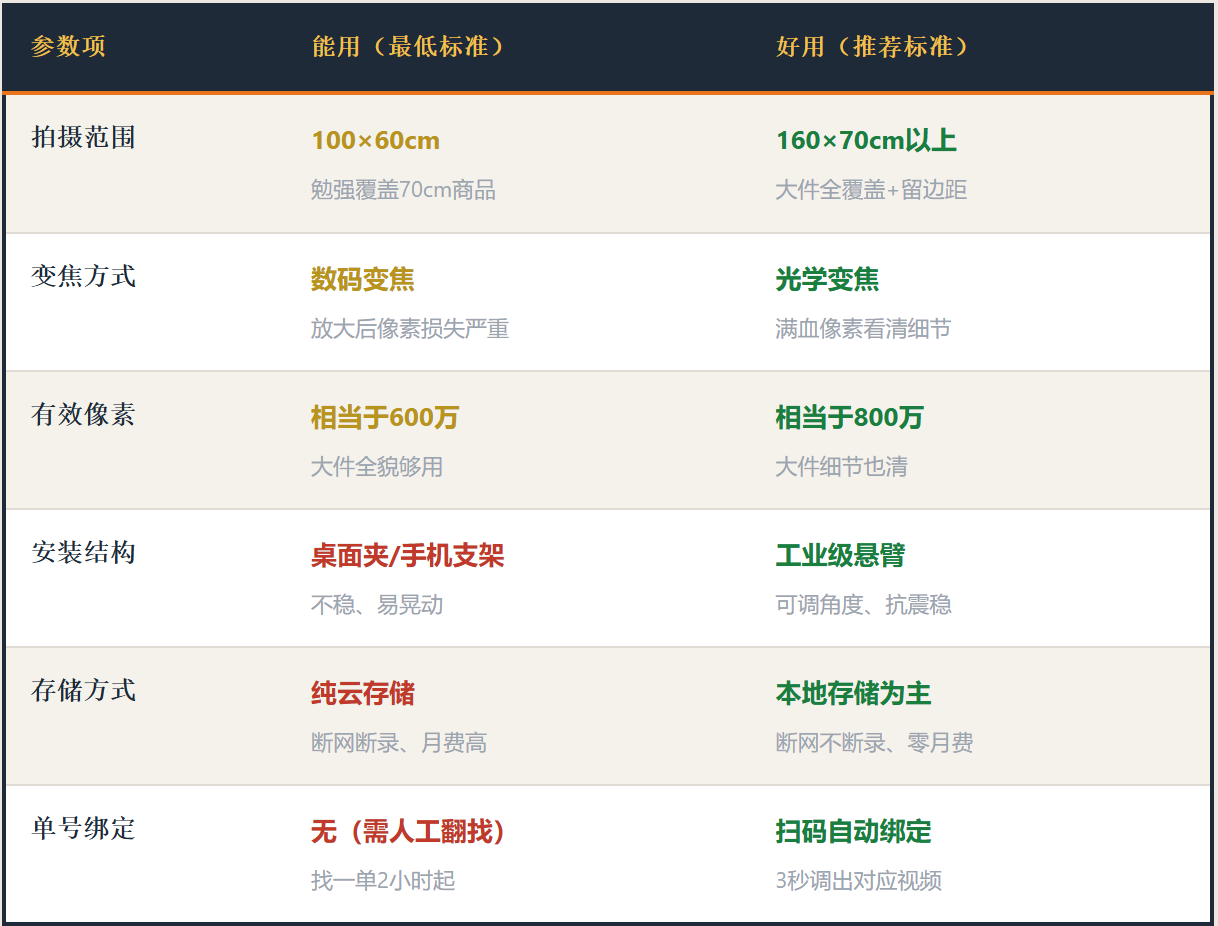
When selecting equipment, large-item sellers should focus on these 6 parameters. The comparison table below lists the standards for "barely usable" versus "truly effective":
Parameter
Barely Usable (Minimum)
Recommended (Safety Line)
(Table content inferred from context throughout article)
If large-item sellers only meet the "barely usable" standard, they will likely fail to provide evidence when return disputes arise. The recommended standard is the minimum safety line for large-item seller protection.
IV. Selection Recommendations for 4 Major Large-Item Categories
Different large-item categories have vastly different packing scenarios, so selection cannot be one-size-fits-all. Below are targeted recommendations for 4 high-frequency large-item categories (all within the inboz-Plus 160×70cm field of view):
[Category 1] Fishing Gear / Outdoor (Fishing Rods / Tackle Boxes / Reel Cases) – 120–160cm
Core dispute points: rod body cracks and missing accessories. Buyers often cite "cracks on the rod body," "missing guide rings," or "missing accessories from the reel case." Packing requires showing the rod body's complete condition, guide ring count, and accessory completeness. Typically packed in long cardboard tubes or PVC pipes.
Key requirements: Field of view must cover the full rod length (140–160cm); must clearly show rod surface condition and guide ring details; pre-tubing state must be filmed.
Recommendation: inboz-Plus Optical Zoom Edition (160×70cm / 8MP equivalent)
[Category 2] Cue Sports / Sports Rods (Pool Cues / Cue Cases / Long Racket Tubes) – 140–155cm
Core disputes: shaft scratches, joint damage, and tip condition. Buyers may cite "scratches on the shaft," "loose front joint," or "detached tip." Packing requires showing the rod is scratch-free, joints are intact, and tip condition is good.
Key requirements: Shaft surface needs pixel-level clarity to prove no scratches; a 145cm cue must fit fully in frame; case accessories (tips/chalk/sleeves) must be shown individually.
Recommendation: inboz-Plus Optical Zoom Edition + PC-Free Bundle (ready to use out of the box, no computer needed)
[Category 3] Winter Clothing (Long Down Jackets / Down Comforters / Heavy Coats) – 120–160cm
Core disputes: fabric damage, uneven filling, and accessory swapping. Buyers may cite "holes in fabric," "clumped down," or "replaced zipper pulls." Packing requires showing intact fabric, complete accessories (hood/belt/fur trim).
Key requirements: A 160cm long down jacket laid flat needs full coverage; must clearly show fabric surface and stitching; removable accessories like fur trim/belt must be shown one by one.
Recommendation: inboz-Plus Optical Zoom Edition (160cm coverage + clear fabric detail)
[Category 4] Home Furniture Large Items (Computer Chairs / Folding Tables / Floor Lamps) – 70–150cm
Core disputes: cosmetic dents and missing accessories. Missing wheels on chairs, corner dents on tables, and base scratches on lamps are frequent return reasons. Packing requires showing undamaged exterior and complete accessories (screws/wrenches/manuals).
Key requirements: Computer chair ~70cm fits well in frame; folding tables ~120–150cm need full coverage; must clearly show edge/corner condition and accessory count. Packing time is 3–5 minutes longer than small items.
Recommendation: inboz-Plus Optical Zoom Edition (160cm coverage + clear dent/scratch visibility)
V. inboz Large-Item Packing Surveillance Solution
Addressing the 6 major needs of large-item packing surveillance, here is how inboz product capabilities align:
[inboz Core Capabilities × Large-Item Scenarios]
160×70cm Field of View — Covers the complete packing table for large items from 70–160cm such as fishing rods, pool cues, and long down jackets. One continuous shot captures the entire item.
Optical Zoom (equivalent to 8MP) — Maintains full-pixel output at any magnification, clearly capturing rod cracks, fabric damage, and accessory details.
Scan-to-Bind — Scanning the tracking number automatically starts recording; upon completion, automatically associates the video with that number. Retrieve historical videos in 3 seconds by entering the number.
Local Storage — Hard drive/TF card storage, keeps recording even without internet, no monthly fees. 1TB stores 2–3 months of large-item video.
Industrial-Grade Articulated Arm — Supports vertical adjustment + horizontal rotation, shock-resistant and stable. Won't shake when workers walk by during packing.
[Decision Tree for Large-Item Sellers]
Maximum item side length ≤ 70cm → inboz-Se Digital Zoom Edition is sufficient (118×67cm coverage)
Maximum item side length 70–120cm → inboz-Plus Optical Zoom Edition (160×70cm coverage, ample margin)
Maximum item side length 120–160cm → inboz-Plus Optical Zoom Edition (160×70cm provides exact full coverage)
Daily order volume > 200 → PC-Free Bundle (¥2,800, built-in host, no computer dependency)
VI. Standardized Packing Video Recording Process for Large Items
With the right equipment, you also need the right process. Follow these 5 steps for large-item packing video recording:
01 Full View Display → 02 Detail Close-up → 03 Scan-to-Bind → 04 Packaging Process → 05 Sealing & Labeling
(Capture full item state) → (Zoom in on key areas) → (Associate tracking number) → (Record entire process) → (One continuous shot)
[Two Key Actions for Large-Item Recording]
Full View Display — Place the item on the packing table and first capture a full-view frame showing the complete item state. For large items, always show the full view before the details—never reverse the order. If you show details first then zoom out, the detail footage is lost.
Detail Close-up — Use optical zoom to focus on the rod surface, fabric, accessories, or other areas buyers might dispute. Pause for 3–5 seconds on each area. These close-up shots are the core evidence for future after-sales claims—the only proof that "there were no cracks/scratches at shipment."
Large-item packing surveillance selection boils down to three rules: field of view exceeding the item by 20cm, optical zoom for clear details, and scan-to-bind for tracking numbers. Get these three right, and you can win 90% of large-item return disputes.
A single large item is worth hundreds to thousands of yuan; one return dispute can cost 1.5–2 times the item's value. Rather than scrambling to dig through surveillance after a dispute arises, make the right choice at the selection stage.
Stop applying small-item surveillance logic to large items—products over 70cm require full coverage + optical zoom + tracking number binding, not a 4K camera that can't even fit the full frame.